
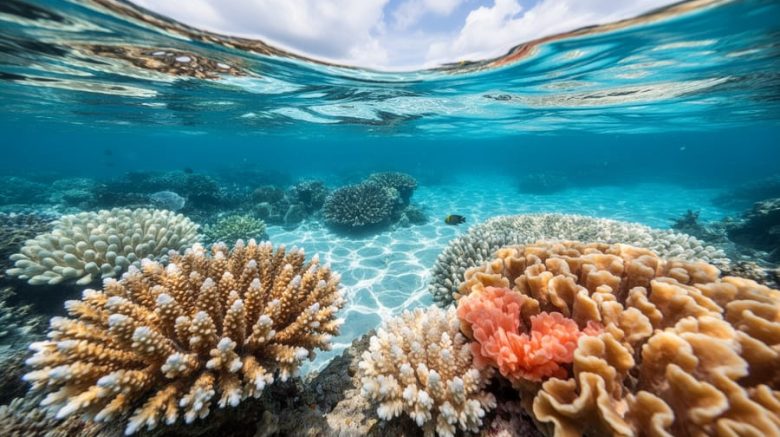
A climate tipping point is a threshold beyond which small changes can lead to significant and often irreversible shifts in Earth’s natural systems. When we cross these boundaries, parts of our climate may not return to their original state even if we stop or reverse the warming that triggered them.
The question of “when” isn’t simple because climate change doesn’t flip irreversible all at once. Think of it like dominoes arranged in patterns across the planet. Some are already falling. At 1.4°C of global warming, warm water coral reefs are crossing their thermal tipping point and experiencing unprecedented dieback. As we approach 1.5°C overall, based on findings from the Global Tipping Points Report synthesized for COP30 in 2025, Earth’s climate and nature are already passing critical thresholds.
Here’s what matters for you right now: irreversibility doesn’t mean helplessness. While certain changes may be locked in for coral reefs at current temperatures, many tipping points still lie ahead, and the severity of their impacts depends entirely on choices we make today. The Dartington Declaration, agreed upon by scientists in July 2025, emphasizes that we’re in a window where action genuinely shapes outcomes.
This article will walk you through what irreversible actually means in climate terms, which tipping points are most vulnerable, how these cascading changes work, and most importantly, what you can do about it. You’ll understand the science without getting lost in jargon, see which thresholds we’re closest to crossing, and discover how individual and community actions still make a measurable difference. The timeline is urgent, but the door to meaningful action remains open.
What Climate Change Irreversibility Means
Climate change irreversibility describes the point at which Earth’s natural systems can no longer recover their original state, even if we stop emitting greenhouse gases entirely. Once we cross certain critical thresholds, the damage becomes locked in for decades, centuries, or permanently. Think of it like pushing a boulder uphill: below a certain point, you can still roll it back down; past the peak, gravity takes over and there’s no stopping it.
These critical thresholds are called tipping points. A tipping point is a threshold beyond which small changes can lead to significant and often irreversible shifts in a system. Below the threshold, the system remains relatively stable. Cross it, and the system can flip into a fundamentally different state that persists even if conditions improve. We’re seeing this happen right now. As global warming approaches 1.5°C, Earth’s climate and nature are already passing tipping points. At 1.4°C of warming, warm water coral reefs are crossing their thermal tipping point and experiencing unprecedented dieback.
- Tipping Point
- A critical threshold where a small additional change triggers a large, often permanent shift in how a system functions.
- Irreversible Change
- Damage or transformation to natural systems that persists for centuries or longer, even after the original cause is removed.
- Threshold
- The specific level of warming or environmental stress at which a system can no longer maintain its current state and begins to transform.
- Cascading Effects
- When one tipping point triggers others in sequence, like dominoes falling, amplifying changes across interconnected Earth systems.
Passing an irreversible tipping point means a system would not revert to its original state even if the forcing lessens or reverses. There is growing uncertainty about how close we are to irreversible changes in major geophysical systems, which makes understanding these thresholds more urgent than ever. The concept matters because it marks the difference between damage we can still undo and changes we’ll live with for generations.
How Climate Tipping Points Work
The Threshold Concept
Think of balancing a marble on top of a bowl. For a while, you can tilt the bowl slightly and the marble rolls back to center. Push it a bit more and it still settles. But tilt past a certain angle and the marble suddenly rolls over the edge and drops to a completely different position. No amount of careful tilting will put it back where it started.
That’s how climate tipping points work. Earth’s systems can absorb stress and stay relatively stable for years, even decades. Temperatures inch up, ice melts gradually, weather patterns shift a little. But these systems aren’t endlessly flexible. Each one has a threshold where the forces holding it in place can no longer win against the forces pushing for change.
Cross that line and the system doesn’t just bend further. It breaks into a new state. What took centuries to build can unravel in years. A forest becomes a grassland. A current stops flowing. A glacier that’s been there for millennia disappears, and the landscape it shaped goes with it. The critical point isn’t that change happens fast after the threshold. It’s that turning back becomes impossible, even if we stopped adding carbon to the atmosphere tomorrow.
Cascading Changes Across Systems
One tipping point rarely acts alone. Earth’s systems are deeply interconnected, which means crossing a single threshold can set off a chain reaction that triggers others. Think of it like knocking over the first domino in a line: the initial fall creates momentum that topples the next, then the next, amplifying the impact far beyond where it started.
When one system shifts, it alters the conditions for neighbouring systems. For example, melting ice sheets don’t just raise sea levels. They release massive amounts of freshwater into the ocean, which can disrupt ocean currents that regulate weather patterns across entire continents. Those disrupted currents then affect rainfall, which impacts forests and soil systems thousands of miles away. A weakened forest absorbs less carbon dioxide, accelerating warming, which melts more ice. The cycle feeds itself.
Scientists call this cascading change because each tipped system becomes a new forcing factor for others. The 2025 Global Tipping Points Report highlights how these interconnections create catastrophic consequences that multiply faster than the sum of individual changes. Once several dominoes have fallen, the combined momentum becomes extremely difficult to slow or reverse, even if we reduce emissions. That’s why understanding these connections matters: preventing one tipping point protects multiple systems downstream.
Types of Climate Tipping Points We’re Facing
Ocean and Marine Systems
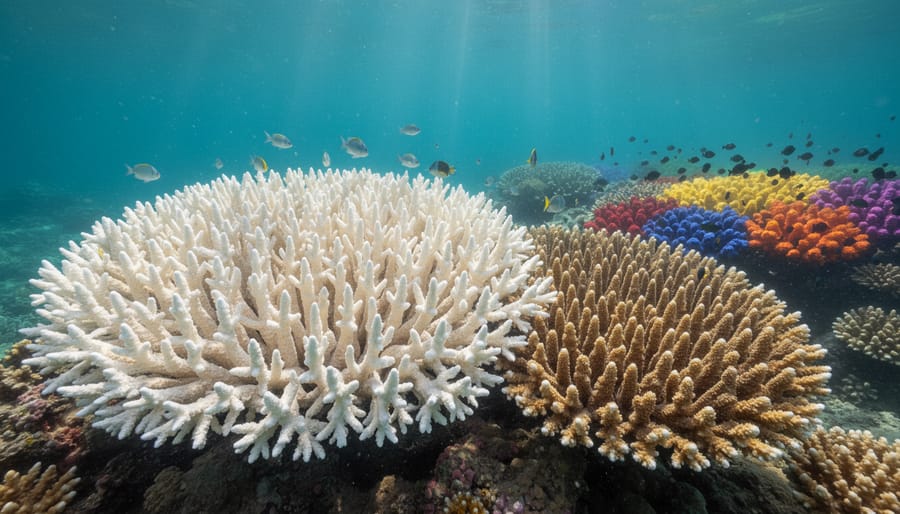
Our oceans are sending some of the clearest distress signals yet. At 1.4°C of global warming, warm water coral reefs are crossing their thermal tipping point and experiencing unprecedented dieback, a threshold scientists have verified as a reefs tipping point near 1.4°C of warming. When ocean temperatures exceed the range corals evolved to tolerate, they expel the algae they need to survive, bleaching white and often dying within months. What makes this irreversible is that even if we stabilize temperatures tomorrow, damaged reef ecosystems cannot regenerate at their historical scale and complexity within human timescales.
Beyond coral reefs, other marine tipping points loom. Ocean currents that distribute heat around the planet face disruption as melting ice dilutes seawater salinity. Marine oxygen levels are dropping in warming waters, creating expanding dead zones where fish and shellfish cannot survive. Each of these systems has its own threshold, and once crossed, the changes ripple through ocean food webs that billions of people depend on for protein and livelihoods.
Ice and Polar Systems
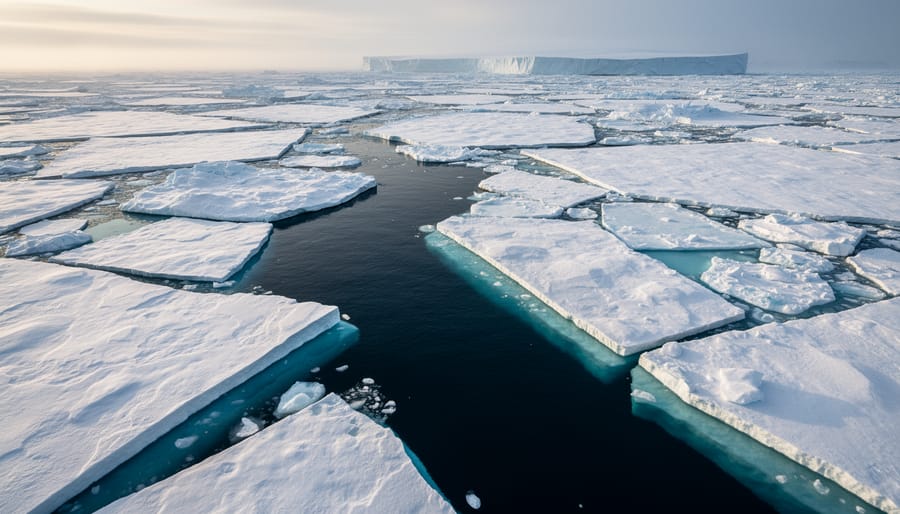
Polar regions hold some of the most vulnerable tipping points on the planet. Greenland’s ice sheet begins irreversible melting once temperatures rise 1.5-2°C above pre-industrial levels, a threshold we’re rapidly approaching. Once started, this collapse continues for centuries regardless of emission cuts, eventually raising sea levels by several meters. West Antarctica faces a similar fate; warming ocean water eats away at the ice shelves that hold back massive glaciers, triggering runaway retreat even if we cool the planet afterward.
Permafrost thaw presents a different danger. These frozen soils across the Arctic store twice as much carbon as the entire atmosphere. As they warm, microbes wake up and start breaking down organic matter, releasing carbon dioxide and methane, both potent greenhouse gases. This creates a feedback loop: warming thaws more permafrost, which releases more gases, which causes more warming. Scientists have observed accelerating thaw in regions that remained stable for thousands of years.
Arctic sea ice loss, while reversible in theory, fundamentally changes polar ecosystems and weather patterns. Darker ocean water absorbs far more heat than reflective ice, amplifying warming in a region already heating twice as fast as the rest of the world. Each of these systems connects to others, meaning crossing one threshold makes the next more likely.
Atmospheric and Weather Patterns
Our planet’s atmospheric circulation patterns and weather systems are remarkably stable, until they’re not. These massive conveyor belts of air and moisture have organized life on Earth for millennia, delivering seasonal rains to billions of people and regulating temperatures across continents. When these systems cross their thresholds, the shifts can be swift and potentially permanent.
The West African monsoon, for example, sustains agriculture and water supplies for hundreds of millions of people. As warming intensifies, this critical rainfall pattern could weaken or shift dramatically, turning farmland into desert. Similarly, the Atlantic Meridional Overturning Circulation (AMOC), which carries warm water north and cold water south, shows signs of slowing. If it collapses, Europe could face much colder winters while tropical regions experience intensified heatwaves and solar energy demands would spike unpredictably.
Jet stream patterns are already behaving erratically, locking weather in place for longer periods and causing both droughts and floods to persist. Once these atmospheric highways reorganize around a new warming baseline, they may not return to their previous paths even if we stabilize temperatures, leaving communities to adapt to radically different rainfall and temperature patterns than those their infrastructure was built for.
When Are We Crossing These Points?
We’re living through the answer to the timing question right now. As global warming approaches 1.5°C above pre-industrial levels, Earth’s climate systems are already crossing critical thresholds rather than waiting for some distant future date. The evidence from the Global Tipping Points Report 2025, synthesized as COP30 approached, shows we’re not asking “when will it happen” anymore, we’re asking “which systems are tipping right now, and which are next?”
The clearest example is warm water coral reefs. At 1.4°C of global warming, these vital ecosystems are experiencing unprecedented dieback, crossing their thermal tipping point in real time. This isn’t a projection, it’s happening as you read this. The Great Barrier Reef has suffered multiple mass bleaching events in recent years, and recovery becomes less likely with each additional fraction of a degree.
Scientists at the Global Tipping Points Conference, which produced the Dartington Declaration in June and July 2025, emphasized growing uncertainty about how close we are to irreversible changes in other major geophysical systems. Ice sheets in Greenland and West Antarctica show accelerating melt rates. Permafrost in the Arctic is thawing decades ahead of earlier predictions, releasing methane that accelerates warming. The Atlantic Meridional Overturning Circulation, which regulates weather patterns across continents, shows signs of weakening.
The honest answer is that we don’t have precise dates for when each system will cross its point of no return. What we do know is that every tenth of a degree matters enormously. The difference between 1.5°C and 2°C isn’t just half a degree, it’s the difference between manageable disruption and catastrophic, irreversible change across multiple interconnected systems. Some thresholds are being crossed now. Others sit just ahead. The timeline for meaningful action isn’t measured in comfortable multi-decade plans anymore, it’s measured in the choices we make this year and next.
Where Climate Irreversibility Affects Real Lives
Guiding Climate Policy and Action
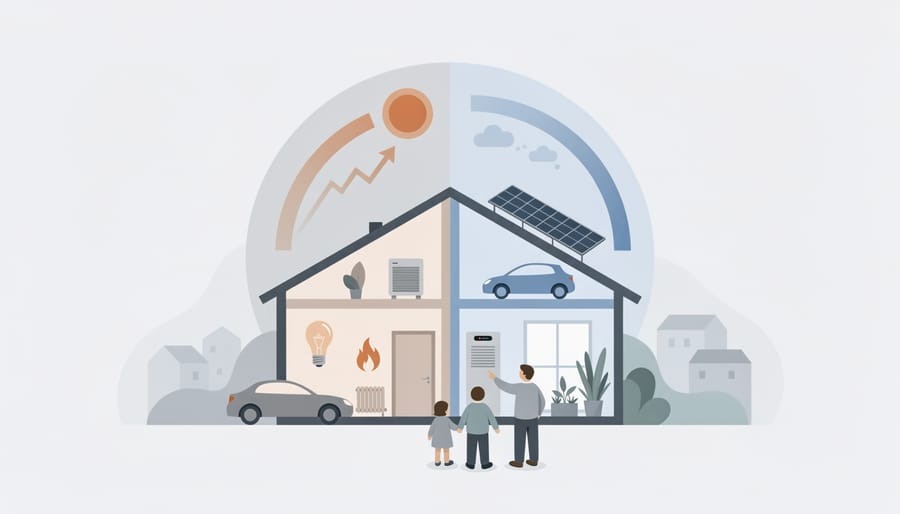
Understanding when Earth’s systems could cross irreversible tipping points has transformed how governments and international bodies approach climate action. When scientists confirmed that warm water coral reefs are crossing their thermal tipping point at 1.4°C of global warming, policymakers gained a concrete benchmark, something more urgent than distant 2100 projections. The 2025 Global Tipping Points Report and Dartington Declaration, agreed at the Global Tipping Points Conference in June-July 2025, now inform international climate negotiations by emphasizing that we’re approaching 1.5°C with several Earth systems already tipping.
This science drives shorter action timelines. Nations crafting emissions targets increasingly reference specific thresholds rather than vague long-term goals. Local governments use tipping point research to prioritize resilience infrastructure, decisions about solar energy resilience or home energy storage carry more weight when leaders understand what becomes irreversible if warming continues. The growing uncertainty about how close we are to irreversible changes actually accelerates policy action: when scientists say they don’t know exactly where the threshold lies, decision-makers realize delay itself is the biggest risk. This shifts climate policy from managing distant problems to preventing imminent, permanent losses.
Informing Community and Individual Choices
Understanding these thresholds matters for decisions we make closer to home. When your community knows that coral reef dieback begins at 1.4°C and we’re already approaching 1.5°C globally, it changes conversations about local resilience. Coastal towns start prioritizing ecosystem-based flood protection now rather than waiting for catastrophic storms. Cities invest in green infrastructure and cooling systems as they recognize that extreme heat will intensify, not reverse. Residents learn heatwave safety tips and push for tree-planting programs that create shade and reduce urban heat islands.
For individuals, awareness of irreversible change shifts perspective from “someday” to “today matters.” Knowing that feedback loops can accelerate beyond our control makes reducing your carbon footprint feel urgent, not symbolic. People switch to renewable energy, cut food waste, choose sustainable transport, and pressure local businesses to adopt greener practices. These aren’t just good habits anymore, they’re contributions to keeping Earth systems from cascading past more tipping points. Every fraction of a degree we avoid matters when thresholds are this close.
What You Can Do Right Now
Understanding tipping points isn’t just about science, it’s a call to action. Every choice you make today helps slow our approach to irreversible thresholds, and the collective impact of individual actions is real. You don’t need to wait for perfect policies or global agreements to make a difference.
Start by cutting your energy use at home. Switch to LED bulbs, unplug devices when not in use, and adjust your thermostat by just a few degrees. These simple changes reduce the fossil fuel demand that drives temperature increases. One family in Vermont cut their electricity bill by 40% in six months by tracking their usage and making targeted changes, proving that small steps add up quickly.
Here are immediate actions you can take:
- Replace your five most-used light bulbs with LEDs and save hundreds of pounds of CO2 annually
- Cut food waste by planning meals and composting scraps, reducing methane emissions from landfills
- Choose reusable bags, bottles, and containers to decrease plastic production and its carbon footprint
- Walk, bike, or carpool for short trips instead of driving solo
- Support wind and solar growth by choosing renewable energy from your utility provider
- Talk to friends and family about climate action, spreading awareness that motivates others
- Contact local representatives to advocate for climate policies that accelerate the transition away from fossil fuels
Your voice matters too. When you speak up at city council meetings or contact your representatives about climate action, you help create the political will that drives systemic change. A group of homeowners in Colorado successfully convinced their town to commit to 100% renewable electricity by 2030 simply by showing up and asking.
The window to prevent the worst cascading effects hasn’t closed. Your daily choices, from what you eat to how you power your home, collectively determine how fast we approach those critical thresholds. Act now, and you become part of the solution that keeps hope alive.
Common Questions About Climate Irreversibility
We know climate tipping points can sound confusing, especially when you’re trying to figure out what they mean for the future and whether we’ve already passed the point where action matters. Here are straightforward answers to the questions people ask most often.
What is a tipping point?
A tipping point is a threshold beyond which small changes can lead to significant and often irreversible shifts in a system. Think of it like a boulder balanced on a hilltop: once it tips over the edge, it rolls downhill on its own momentum and won’t return to its original position even if you stop pushing.
What are climate change tipping points?
Climate tipping points are specific thresholds in Earth’s natural systems, like ice sheets, coral reefs, or ocean currents, that, once crossed, trigger large-scale, lasting changes. At 1.4°C of global warming, for example, warm water coral reefs are crossing their thermal tipping point and experiencing unprecedented dieback.
Why are we approaching irreversible change?
We’re nearing irreversible change because global temperatures are approaching 1.5°C above pre-industrial levels, and Earth’s climate and nature are already passing tipping points at this level of warming. The accumulated greenhouse gases in our atmosphere are pushing interconnected systems past their stability limits.
Is it already too late to do anything?
No. While some systems like warm water coral reefs are crossing thresholds now, meaningful action today can still prevent the worst cascading effects and protect many other systems from tipping. Every fraction of a degree we prevent matters enormously for communities, ecosystems, and future generations.
The reality is that there’s growing uncertainty about how close we are to irreversible changes in major geophysical systems, which the 2025 Global Tipping Points Report and the Dartington Declaration, agreed at the Global Tipping Points Conference in July 2025, have worked to clarify. Passing an irreversible tipping point would mean a system wouldn’t revert to its original state even if we reduce emissions or reverse warming, but that doesn’t mean every system will tip simultaneously or that all hope is lost.
Understanding these distinctions helps you see where your efforts can make the biggest difference. The window for preventing the most catastrophic cascading changes is narrowing, but it’s still open, and the actions you take in 2026 genuinely influence which systems we protect and which thresholds we avoid crossing next.
We’re standing at a crossroads where some Earth systems are crossing tipping points right now, with warm water coral reefs already experiencing unprecedented dieback at 1.4°C of warming. That’s sobering. But here’s what matters most: we haven’t crossed every threshold, and the actions we take today directly determine which cascading effects we can still prevent.
The science is clear that meaningful climate action right now can stop us from triggering the worst domino effects across interconnected systems. Every fraction of a degree we avoid matters enormously because it keeps additional tipping points out of reach. This isn’t about achieving perfection or fixing everything overnight. It’s about the collective impact of millions of people making sustainable choices, reducing their carbon footprint, and demanding systemic change.
You have real power here. When you cut your household waste, choose renewable energy, recycle properly, or pressure companies and policymakers to act, you’re part of a global movement that’s buying us time and options. Communities everywhere are proving that sustainable living works and spreads.
Yes, the timeline is urgent. But urgency doesn’t mean hopelessness. It means your choices today carry extraordinary weight. The threshold between manageable change and runaway catastrophe hasn’t fully closed yet. What you do this week, this month, this year genuinely shapes which future we get. That responsibility is heavy, but so is the opportunity. Let’s use it.